
All You Need to Know About Minimum Bend Radius
In the world of tube bending, there is an important concept: minimum bend radius you should know, because each specific project will have different requests on bend radius, and the choice of a different tube bending machine and bend die determines whether you can achieve their minimum bend radius request.
What is CLR?
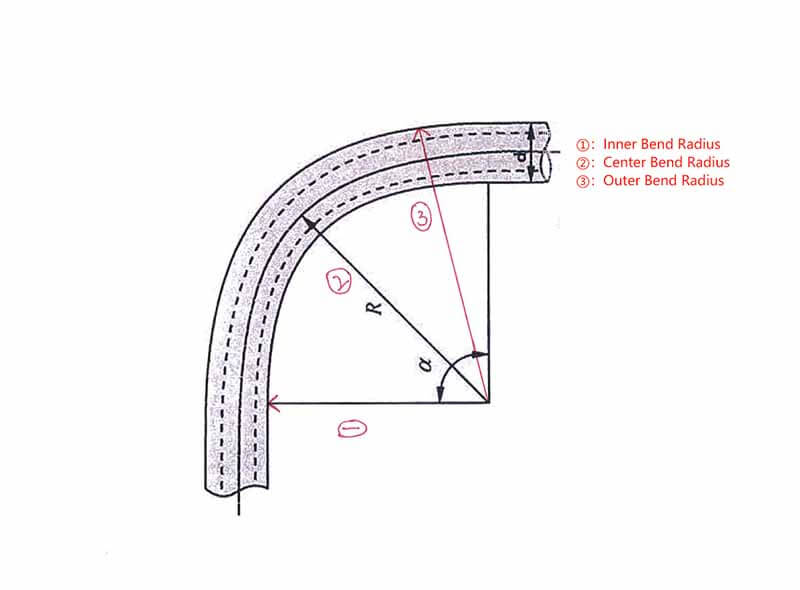
Before talking about the minimum bending radius, we should know what is CLR? As you can see in the above photo, the CLR stands for center line radius, which is the distance from the center line of the tube to the center of the bend. This is a very important tube bending parameter.
What is Minimum Bending Radius?
The minimum bend radius is the smallest radius that your tube or pipe can be bent without causing deformation, damage, or structural failure. This parameter determines how tight a bend can be made on the tube bending machine or how tight the bending radius is requested to be bent without compromising the integrity of the bending material.
The Benefits of Tight Radius Tube Bending
When we talk about the minimum bending radius, it means we want to bend the tube as tightly as possible. Do you know why?
Space Efficiency
Some projects require tight radius tube bending, may have limited space, and they want a more compact design, such as in automotive and aerospace engineering.
Design Flexibility
The ability to create sharp bends enables more creative and functional designs, accommodating complex geometries and unique shapes.
Improved Aesthetics
Some product designs require tight radius bends to increase their visual appeal.
Weight Reduction
Tight radius bending generally does not require fittings and joints, so this will reduce the overall weight of the structure.
Reduced Material Waste
The tight radius tube bending is always related to the compact design of the whole project, so it means such a request can help you to reduce the material wastage.
Enhanced Performance
Tight radius bends can improve fluid flow in piping systems by reducing turbulence and pressure loss, leading to better system efficiency.
The Application Where Need Tight Radius Tube Bending
Tight radius tube bending can be required by any application that needs this bending technique. Below are the common applications that use tight radius tube bending a lot.
Automotive Industry
For bending the exhaust system, chassis and frame components, fuel lines, and brake lines, their designs are required to bend the tube with tight radius.
Aerospace Industry
To bend the aircraft components, such as fuel lines, hydraulic systems, and interior frameworks, some of their designs require tight bends.
HVAC Systems
To bend the tube in heating, ventilation, air conditioning systems, and refrigeration lines, tight tube bends are required.
Furniture Design
The design of furniture can be varied according to market requirements, so you can always see that tight radius tube bends are always used in both traditional and modern furniture.
Marine Applications
In boat construction, such as railings, frames, and piping systems are always required tight tube bends.
What Types of Tube Bending Machine Can Be Used for Tight Radius Tube Bending?
There are many types of tube bending machine can be used to bend tubes, and each of them can be used to bend tight bending radius. The difference is that their tight bending radius standard is different. View the common tube bending machines used in industrial production.
What is the Minimum Bending Radius of our Mandrel Benders?
The normal tube bending radius (CLR) is ≥ 2 times the tube diameter, and the normal straight distance is ≥ 1.5-2 times the tube diameter, so the bending radius less than 2 times of tube diameter can be regarded as the tight tube bending radius.
TubeBenderN is the professional manufacturer of mandrel bender in China. Our minimum bending radius for a tube can achieve 1.5 times the tube’s outer diameter. For the bending radius less than 1.5 times the tube diameter, please send your detailed request to our engineer, and we will see how to customize the machine to make your tube bending design come true.
Looking for a tube bending solution for your business? Contact our engineer below, and you will get your answer!
Denis Lau
Denis Lau has 20 years of work experience in the metal processing industry. His major in university was mechanical engineering, and after graduation, he started from the bottom of the workshop, gaining extensive hands-on professional experience and the ability to tackle challenges from various industries.


